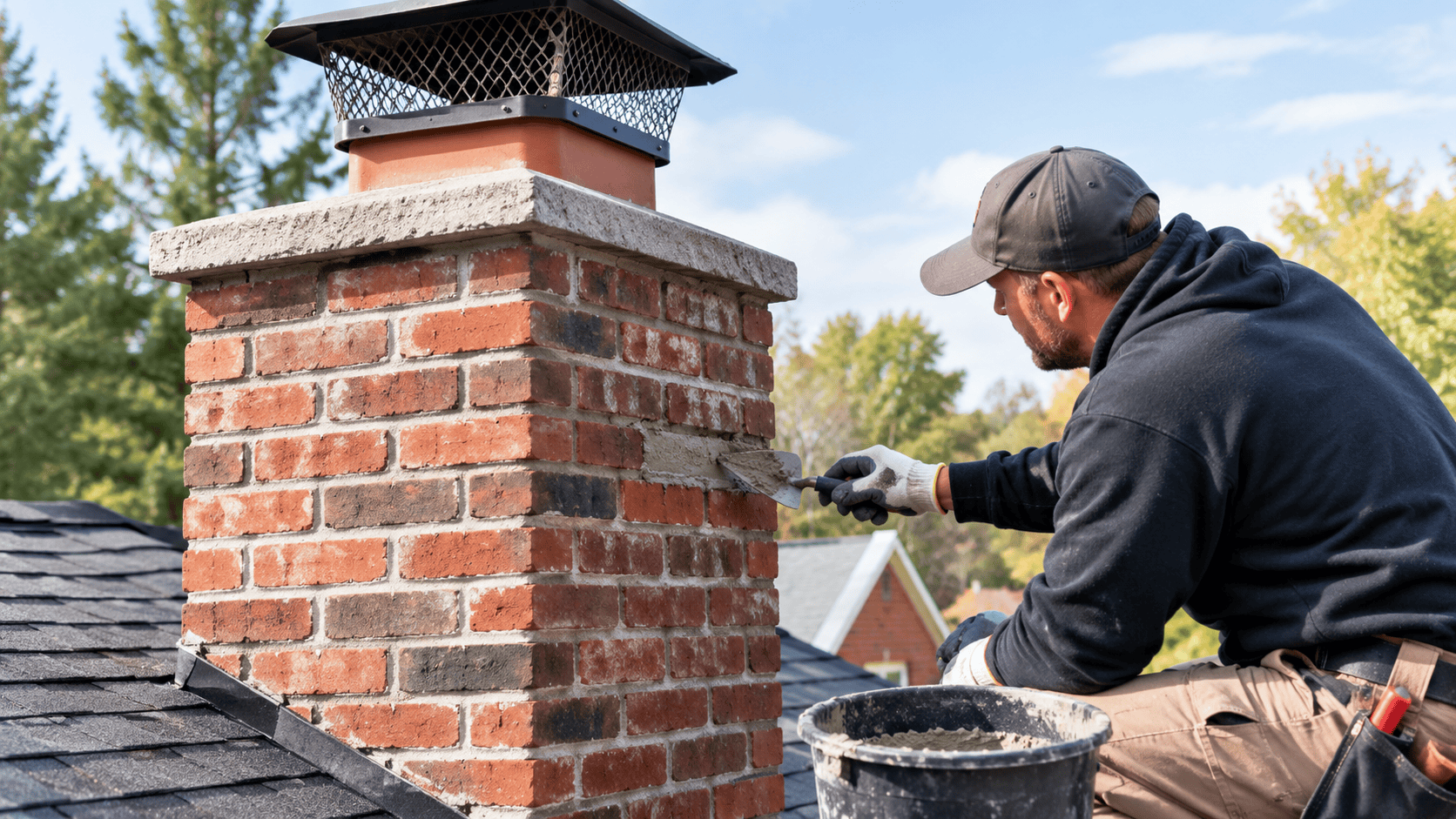
The sometimes-forgotten part of your chimney that can save or cost you thousands of dollars.
Most people who own a home do not think about what's within their chimney. You strike a match, stay warm, and continue with your evening. The chimney works silently and without any visibility until it doesn't.
Did you know that the most important part of your chimney is the part you can't see from the street? It's the layer you cannot see.
What’s Actually Happening Inside Your Chimney
Each time you start a fire, your chimney is faced with something very harsh. The flue may reach temperatures of more than 1,000 degrees F. Combustion gases, some of them poisonous, flow upwards at high speed. Moisture, creosote, and acidic byproducts stick to all surfaces they come in contact with.
Your chimney's exterior masonry is exposed to the weather. But the inner flue? That's another conflict altogether.
Fires start, CO leaks begin, and slow invisible structural damage creeps over the years on the inside of your flue. No one has ever looked, and most homeowners don't know this is happening, except for the tools, and you can't do anything with them.
This is the part of chimney maintenance that is seldom discussed, as it's not dramatic. It's not a broken brick on your roof line or a crack in your mortar. It's internal. Quiet. But often overlooked until it's an emergency.
The Liner Is Not Optional
The flue liner is the lining of the chimney that encircles the entire chimney. It has three characteristics that no other product in the house can match:
It contains combustion products
If the liner is not working properly, hot gases and embers can escape through the masonry into the wooden structure of your home. The National Fire Protection Association says without a doubt that an unlined chimney is a fire hazard.
It protects your masonry from deterioration.
Gases from combustion include acids. Gradually they consume brick and mortar from within after years. The liner absorbs the brunt of the impact and saves your chimney from suffering it. Without the liner, the chimney will last a lot shorter.
It improves your fireplace's performance.
If the liner is properly sized and reasonably in good shape, it will help create the proper draft, the airflow that sucks smoke up rather than pushing it back into your home. Smoking fireplaces are often due to a damaged or undersized chimney.
Chimney liners aren't an optional extra. These form the "heart" of a safe and working chimney system.
When Things Go Wrong (And They Do)
Liners are susceptible to failure in very subtle ways. The most common type of home tile liners in homes built before the 1990s is clay tile liners, which crack under thermal stress. It is not necessary for a fire to start in a chimney to cause damage. The tiles break after a number of years due to normal repeated heating and cooling. Once there is one crack, it's already broken.
Cast-in-place liners may split. The flexible stainless steel liners can rust, particularly in gas-heated houses where gases produced are very acidic. Camera inspection is a very effective way to discover even the smallest hairline fractures, and it is suggested that even an apparently perfect liner may have them.
The issue is that a cracked liner will not come to you in an obvious manner. Your fireplace continues to function. You keep using it. The damage to the masonry, oxidation of the air, loss of flue strength, and so on continue quietly.
When most homeowners discover that their liner needs repair, the cost is much greater than it would be if the repair work had been completed a year or two earlier.
The Maryland Factor
Homeowners in this area are dealing with a few particular problems that are not common in more moderate climates, concerning their chimney.
Masonry does not do well in Maryland winters. Water expands and deteriorates quicker than in warmer states as it is driven into the micro-cracks by repeated freeze-thaw cycles. In summer, the high humidity also brings its own issues; moisture can be retained in the flue, which causes creosote to accumulate and hastens the corrosion of the liner.
Clay tile liners are often found in older homes and, in many cases, have been in place for more than 20 years. Many were not retrofitted to meet the change in gas appliance combustion chemistry when many of the homes were transitioned from wood-burning to gas appliances.
If you own a home and want chimney services that will meet your needs, Damascus, Maryland, has certified professionals who know the specific conditions of the area: the movement of the soil, the local patterns of climate stress, and the older homes that make up much of the region.
What a Real Inspection Actually Tells You
The only way to determine the condition of your liner is to have a Level 2 chimney inspection using video camera equipment. Visual inspection from the top of the chimney gives little information on what is occurring in the upper parts of the chimney.
With proper camera inspection, one can see the following:
- The location and severity of cracks.
- Patterns of creosote accumulation that are signs of draft issues
- Distances between liner segments
- Moisture intrusion or spalling.
That is not a sales pitch; it's just basic diagnostic logic. You don't expect a physician to make a diagnosis after examining your skin.
The Bottom Line
You may never have thought about your chimney liner, but it is the most important part of your chimney. It's the difference between a fireplace that's a warm, reliable heating appliance or a slow-growing problem in the middle of your home.
The cure, if it is discovered in time, is often simple. Ignoring it doesn't have the consequences of not doing it.
The first place to look is your chimney if it hasn't been inspected with a camera in the past 3 years. Not because it's definitely not OK, but because you really don't know; the true danger is a lack of knowledge.